Tel: 0086-13632687993
  Email: roto@lightvenus.com



 Home
HomeWhy Choose Rotational Molding for Automotive Intake Pipes?
 Mar 19,2026

Why Choose Rotational Molding for Automotive Intake Pipes?
In the realm of automotive component customization, the intake pipe stands as a critical linchpin of the engine's air intake system. Its performance directly dictates engine power output, fuel efficiency, and operational stability, thereby serving as a focal point in vehicle R&D and upgrading. However, as the industry demands increasingly stringent requirements for lightweight design, environmental sustainability, and personalization, traditional processes—such as metal stamping and injection molding—have gradually reached their limits. Issues including excessive weight, susceptibility to corrosion, constrained geometric design freedom, and inherent joint defects have become increasingly prominent.
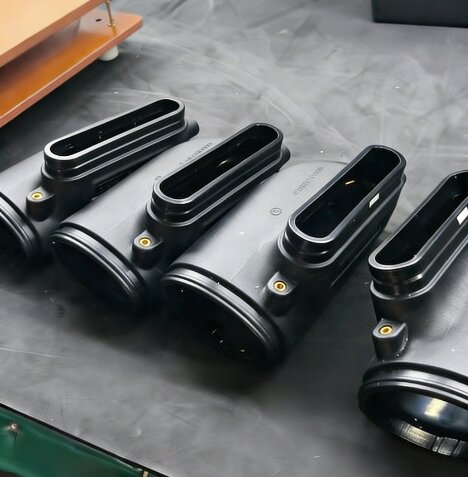
In this context, the innovative application of rotational molding (rotomolding) has pioneered a new pathway for high-quality intake pipe customization, integrating flexibility, reliability, and cost-effectiveness. It is emerging as a pivotal trend in the technological iteration of the automotive industry.
Currently, automakers often confront three major dilemmas:
1. Difficulty in balancing precision and cost-effectiveness.
2. Limited capability in forming complex, organic shapes.
3. Failure to meet rigorous durability and performance standards.
While traditional metal intake pipes offer acceptable strength, they suffer from significant drawbacks: excessive weight increases fuel consumption, while poor corrosion resistance degrades long-term reliability. Additionally, they perform inadequately in noise reduction and shape adaptation, making them ill-suited for the specialized design needs of modern energy vehicles and off-road vehicles.
Ordinary injection molding processes, though capable of lightweight construction, face inherent limitations in fabricating irregular structures. Their joined construction is prone to air leakage and cracking, which directly undermines engine intake efficiency.
The advent of rotational molding technology precisely addresses these pain points.
Rotational molding achieves plastic forming through controlled mold rotation and heating. Its unique processing principle endows intake pipe production with **irreplaceable competitive advantages**. Compared with traditional processes, rotomolded intake pipes enable **one-piece molding without complex auxiliary molds**, completely eliminating joint-related defects, significantly enhancing airtightness, and effectively minimizing power loss due to air leakage. Meanwhile, the design of a smooth inner wall reduces airflow resistance, facilitating complete combustion and aligning with the core goals of weight reduction and emissions reduction—fully consistent with the automotive industry's sustainable development strategies.
For automakers pursuing customization, the core advantage lies in the extreme freedom of shape design. Engine compartments typically feature confined spaces, requiring intake pipes to adapt to complex, irregular contours such as arcs and bends. Rotational molding can accurately produce tapered sections, large-angle elbows, and even integrated structures like noise reduction ducts and sensor mounts—all without subsequent assembly. This greatly improves adaptability, processing efficiency, and reduces customization costs.
In terms of material compatibility, rotational molding supports a wide range of high-performance plastics, including polyethylene and nylon. Rotomolded nylon intake pipes achieve a weight reduction of over 30%** compared to traditional metal components, while maintaining high strength. They excel in withstanding harsh engine compartment conditions (high temperature, vibration, and corrosion) and exhibit exceptional impact resistance, leading to a significantly extended service life. Furthermore, the uniform melting of raw materials during rotation ensures consistent wall thickness and a smooth inner surface, minimizing airflow disturbance to further optimize intake efficiency, meeting automakers' strict quality benchmarks.
Today, rotational molding has become a key solution for automakers to optimize product competitiveness. By partnering with professional rotomolding manufacturers, an increasing number of automakers have realized the customization and upgrading of intake pipes, reducing production costs while comprehensively enhancing overall vehicle performance.
As a leading enterprise in the rotomolding industry, Light Venus Rotational Moulding Factory remains customer-focused, continuously refining its processes and upholding rigorous quality standards. The company is dedicated to delivering practical, cost-effective, and application-specific rotomolded intake pipe solutions tailored to the needs of modern automakers.
 Why Choose Rotational Molding for Automatic Scrubber Water Tank
 You May Also Like



 Tel
Tel
0086-13632687993
 Email
Email
roto@lightvenus.com
 Address
No. 1, Chuangying Road, South Industrial Avenue, Xiaolan Town, Zhongshan City, Guangdong, China

Sophy.Zhong
 Whatsapp