Tel: 0086-13632687993
  Email: roto@lightvenus.com



 Home
HomeWhat are the Advantages of Rotomolding Process in Manufacturing Motorcycle Fuel Tank?
 Apr 23,2026

What are the Advantages of Rotomolding Process in Manufacturing Motorcycle Fuel Tank?
The motorcycle fuel tank is one of the most critical components of a two-wheeler, serving not only as a fuel reservoir but also as a defining aesthetic element and structural component. While traditional manufacturing methods such as metal stamping, blow molding, and injection molding have long dominated the industry, rotational molding (rotomolding) has emerged as a highly viable and increasingly preferred alternative. This thermoplastic processing technique offers a unique set of advantages that make it particularly well-suited for producing motorcycle fuel tanks, especially in an era where design flexibility, weight reduction, and cost efficiency are paramount. Below are the key advantages.
1. Exceptional Design Freedom and Complex Geometry Capability
One of the most significant advantages of rotomolding is its unparalleled design flexibility. Unlike injection molding or blow molding, which are often constrained by parting lines, draft angles, and wall thickness uniformity, rotomolding allows for the creation of highly complex, hollow, one-piece structures with intricate geometries.
For motorcycle fuel tanks, this translates to the ability to:
- Integrate multiple functional features directly into the tank body, such as mounting brackets, baffles, filler necks, and internal chambers, without secondary assembly.
- Produce seamless, stress-free components with uniform wall thickness distribution, even in areas with deep draws or sharp radii.
- Create ergonomic and aerodynamic shapes that align with modern motorcycle styling trends, where the fuel tank often serves as the visual centerpiece of the vehicle.
The absence of high-pressure forces during molding means that designers are not limited by the structural constraints imposed by core pulls or slide mechanisms, enabling more organic and innovative forms.
2. Superior Material Properties and Chemical Resistance
rotomolded fuel tanks are typically made from corrosion-resistant and impact-absorbent thermoplastics such as high-density polyethylene (HDPE) or highly cross-linked polyethylene (XLPE). These materials have excellent toughness and flexibility, allowing the tank to absorb impacts and vibrations without cracking—unlike rigid metal tanks, which can dent, rust, or rupture upon collision, or blow-molded plastic tanks, which are thinner and more prone to stress cracking. The low thermal conductivity of these plastics (only 1% of metal) also reduces the risk of explosion due to high-temperature expansion, and their non-sparking nature during collision further enhances safety by minimizing fire hazards. For off-road motorcycles, which frequently encounter rough terrain and potential impacts, this robust safety performance is particularly indispensable.
3. Seamless Construction and Leak Prevention
Traditional metal fuel tanks are typically fabricated from multiple stamped steel or aluminum sections that are welded together. These weld seams represent potential failure points where leaks can develop due to vibration fatigue, thermal cycling, or corrosion.
Rotomolding produces monolithic, seamless tanks with no joints, welds, or adhesive bonds in the main body. This inherent seamlessness:
- Eliminates leak paths that could lead to fuel loss or safety hazards.
- Reduces the risk of stress concentration points that could crack under dynamic loading.
- Simplifies quality control, as there are no weld inspections or seam integrity tests required.
The result is a component with inherently superior long-term reliability and safety performance.
4. Significant Weight Reduction
Weight reduction is a crucial consideration in motorcycle manufacturing, as it directly impacts fuel efficiency, handling, and overall driving performance. Rotomolded plastic fuel tanks are significantly lighter than traditional metal tanks—typically 30% to 50% lighter—while maintaining equivalent or superior structural strength. For example, a typical rotomolded motorcycle fuel tank weighs around 1.6 kg, compared to much heavier metal alternatives, reducing the overall weight of the motorcycle and easing the strain on mounting structures.
This lightweight advantage translates to tangible benefits for riders: improved fuel efficiency, as the engine has less weight to carry; enhanced maneuverability, particularly for small-displacement motorcycles and off-road models; and reduced fatigue during long rides. Additionally, the lightweight nature of rotomolded tanks simplifies installation and reduces transportation costs for manufacturers, further optimizing the production process.
5. Cost-Effective Tooling and Low-Volume Production
Rotomolding offers significant cost advantages over other manufacturing processes, making it suitable for both small-batch customization and medium-scale production of motorcycle fuel tanks. One of the key cost benefits is lower tooling costs compared to injection molding: rotomolding molds are typically made from steel or aluminum, which are more affordable than the hardened steel required for injection molding, and they are easier to design, modify, and maintain. This makes rotomolding an ideal choice for small-batch production, such as customized or modified motorcycle fuel tanks, where high tooling costs of other processes would be prohibitive.
While the production cycle of rotomolding is longer than that of injection or blow molding, its long-term cost-effectiveness is undeniable. The durability and corrosion resistance of rotomolded fuel tanks reduce maintenance and replacement costs over their lifespan, offsetting any short-term production inefficiencies. Additionally, the process minimizes material waste—with a raw material utilization rate of 85% to 90%—and eliminates the need for secondary operations (such as welding or assembly), further reducing production costs.
6. Integration of Functional Elements and Reduced Assembly
Rotomolding excels at incorporating functional features directly into the molded part, a capability known as "design for integration." For motorcycle fuel tanks, this includes:
- Internal Baffles: Molded-in chambers that reduce fuel sloshing, improving vehicle stability during cornering, braking, and acceleration.
- Mounting Points: Integrated brackets and bosses with threaded inserts or through-holes, eliminating the need for welded-on tabs or separate mounting hardware.
- Ventilation Channels: Complex internal passages for fuel vapor management and evaporative emission control (EVAP) system integration.
- Fuel Level Sensor Mounts: Precisely located bosses for installing fuel gauge senders without additional fabrication.
This integration capability reduces bill-of-materials complexity, assembly time, and potential failure points associated with multi-component assemblies.
7. Environmental and Sustainability Benefits
As the automotive industry increasingly prioritizes sustainability, rotomolding offers several ecological advantages:
- Recyclability: Polyethylene tanks can be ground and reprocessed at end-of-life, unlike coated or painted metal tanks that require complex separation processes.
- Energy Efficiency: The rotomolding process operates at lower pressures and temperatures compared to injection molding, reducing energy consumption per part.
- Material Efficiency: Near-net-shape production with minimal flash or runner waste (unlike injection molding) maximizes material utilization.
- Lightweighting Impact: Reduced vehicle weight translates to lower lifetime fuel consumption and CO₂ emissions.
Additionally, bio-based polyethylene derived from sugarcane ethanol is becoming commercially available, offering a renewable feedstock pathway for rotomolded components.
8. Noise, Vibration, and Harshness (NVH) Damping
Motorcycles transmit significant engine and road vibrations through the chassis. Metal fuel tanks can act as resonance chambers, amplifying noise and transmitting vibrations to the rider.
- Polyethylene's viscoelastic properties provide inherent damping characteristics that:
- Absorb and dissipate vibrational energy.
- Reduce structure-borne noise transmitted through the fuel tank mounting points.
- Improve rider comfort, particularly on long-distance touring motorcycles.
This NVH benefit is difficult to achieve with metal tanks without adding separate isolators or damping pads, which increase cost and assembly complexity.
For custom and cruiser motorcycles where the fuel tank is a primary styling canvas, these options provide manufacturers with differentiation opportunities without the environmental and cost burdens of traditional painting processes.
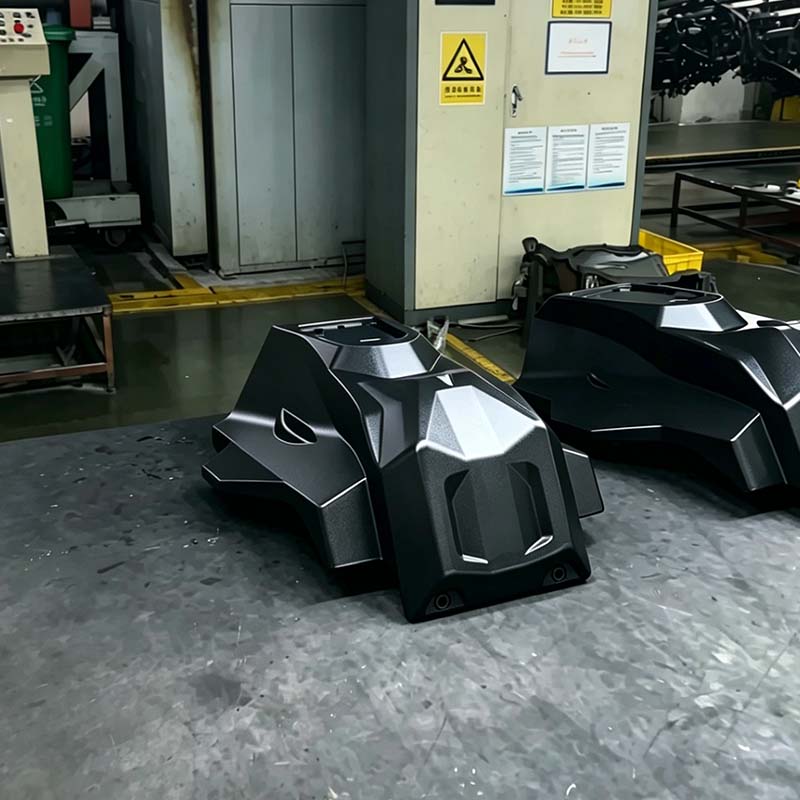
The rotational molding process presents a compelling value proposition for motorcycle fuel tank manufacturing, combining design freedom, material performance, weight reduction, and economic efficiency in a way that traditional methods struggle to match. As motorcycle designs become increasingly sophisticated and manufacturers face pressure to reduce costs, weight, and environmental impact, rotomolding offers a technologically mature and continuously improving solution.
While the process may not entirely displace metal tanks in all market segments—particularly where premium aesthetics or extreme performance demands dictate material choice—it has firmly established itself as the preferred manufacturing route for utility motorcycles, scooters, ATVs, and an expanding range of street and touring bikes. The ongoing development of advanced polyethylene formulations, precision mold-making technologies, and integrated smart manufacturing systems ensures that rotomolding will remain at the forefront of motorcycle fuel tank innovation for years to come.
 Why Large Special-Shaped Off-Road Vehicle Interior Parts Prefer Rotational Molding
 You May Also Like



 Tel
Tel
0086-13632687993
 Email
Email
roto@lightvenus.com
 Address
No. 1, Chuangying Road, South Industrial Avenue, Xiaolan Town, Zhongshan City, Guangdong, China

Sophy.Zhong
 Whatsapp